


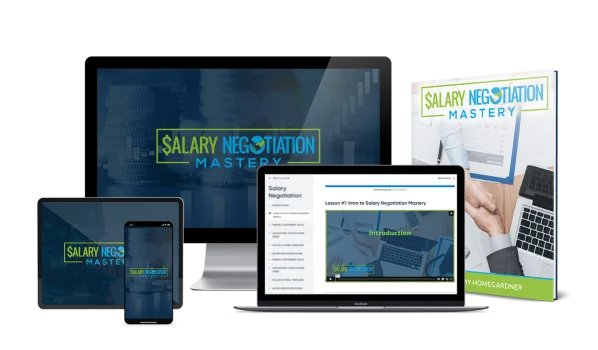
Salary Negotiation Mastery

salary negotiation mastery

The $47,000 Mistake Most Professionals Make in Their First 10 Seconds After Receiving a Job Offer

And the word-for-word response system that gets hiring managers to say "yes" to your counter offer—without sounding greedy, desperate, or difficult

Join 2,847+ professionals who’ve increased their starting salaries by an average of $23,000

salary negotiation mastery

The Story Nobody Tells You

Sarah was thrilled. After three months of grueling interviews, the VP of Marketing offer finally came through: $135,000.

It was more than she made at her current job. It was a dream company. So she did what most professionals do…

She said “yes” immediately.

Why wouldn’t she? She didn’t want to seem ungrateful. She was afraid they’d rescind the offer. She didn’t know what to say. And honestly? The offer already felt like a win.

Six months later, Sarah made a discovery that kept her up at night.

Her colleague Mark—hired two months after her, with less experience—was making $152,000.

Sarah left $17,000 per year on the table.

That’s $85,000 over 5 years. $170,000 over 10 years. And here’s what makes it worse…

Every future raise, bonus, and job offer will be based on this starting point. Sarah’s one moment of hesitation—that 10-second decision to just say “yes”—will cost her $400,000+ over her career.

"Most professionals think negotiation happens AFTER you get the offer. The truth? Everything you do from the first interview determines whether you'll have negotiating power at all."

Why This Keeps Happening


Here’s the uncomfortable truth about why experienced, successful professionals—people who negotiate million-

dollar deals at work—suddenly freeze when it’s their own salary on the line:

1

You haven't negotiated a salary in 7–12 years.

Senior professionals stay at jobs longer. You're rusty because you've had fewer reps than you think.

2

HR knows the game better than you do.

They negotiate dozens of offers per year. You do it once every few years. The playing field is not level.

3

The "negotiation window" is only 48–72 hours.

Most people waste it by either accepting immediately or fumbling through an awkward, unprepared conversation.

68%

of professionals accept the first offer without negotiating

$4K-$12K

average increase for those who DO negotiate

$15K-$50K

average increase at director level and above

Here’s what makes this so frustrating: You’ve spent 15-20 years building your
expertise. You’ve earned this level of compensation. But in that one 
moment when it matters most, you don’t know what to say.

The Turning Point

I’ve coached over 2,800 professionals through their job searches, and I used to think
salary negotiation was simple: “Just ask for 10-15% more.”

But I kept seeing the same pattern…

Smart, accomplished professionals would crush their interviews, land amazing offers…
and then completely fumble the negotiation (or skip it entirely).

The problem wasn’t their skills. It wasn’t their confidence. It was that they were trying to
improvise in a conversation where HR follows a script.

So I created a done-FOR-you system with the exact words to say, when to
say them, and how to respond when HR pushes back
.

No more wondering what to say. No more “winging it.” No more leaving money on the table.

Introduction

Salary Negotiation Mastery

product-image-BxaA9CKl

The word-for-word system that turns the most stressful 10 seconds of your
career into your biggest financial win.

What's Inside

Everything you need to negotiate with confidence—ready to use the
moment you get your offer

Finding Your Market Value 1
MODULE 1

The Salary Negotiation Foundation

How compensation decisions are actually made. Why most people negotiate too late. The mindset shift that creates leverage before the offer.

  • Know the game before you play it
The Pre Negotiation Strategy
MODULE 2

Market Value & Positioning

How to determine your real market value. What actually matters to employers (and what doesn’t).

  • Anchor negotiations with confidence
Module 3 Icon
MODULE 3

Pre-Offer Strategy

What to say before numbers are discussed. How to avoid getting boxed into a low range early.

  • Control the conversation before the offer
Module 4 Icon
MODULE 4

The Negotiation Conversation Scripts

Word-for-word scripts for the actual call. What to say when they make the offer. What to say when they ask for your number. What to say when they push back.

  • Never wonder “what do I say?” again
Module 5 Icon
MODULE 5

The Email Template Library

10 done-FOR-you email templates for every scenario. Copy, customize, send. Takes the stress out of written negotiation.

  • Professionally written emails in minutes, not hours
Module 6 Icon
MODULE 6

Multiple Offer Strategy

How to leverage competing offers without burning bridges. The ethical way to maximize compensation.

  • Turn multiple offers into your biggest advantage
Module 7 Icon
MODULE 7

When They Say “No”

The response playbook with 12 alternative negotiation points. What to negotiate when salary is locked.

  • No doesn’t mean no — it means “not that way”
Module 8 Icon
MODULE 8

Retention Counteroffers

How to evaluate counteroffers from your current employer. When to accept. When to walk away.

  • Navigate counteroffers without regret
Module 9 Icon
MODULE 9

Real Negotiation Breakdowns

7 real case studies with before/after numbers showing $10K–$50K+ increases.

  • Learn from real successes
Module 10 Icon
MODULE 10

The Main Salary Negotiation Guide

The complete written guide with quick reference charts. Everything in one place when it matters most.

  • Your complete negotiation playbook

Real Results From Real Professionals

See what happens when you stop winging it and start using a proven
system

Michael R

Michael R.

Senior Product Manager, Tech Startup
Original Offer $165,000
Final Package $195,000
Increase $30,000

"I was ready to accept the first offer. The scripts helped me professionally ask for more without sounding desperate. The extra $30K happened in one 20-minute phone call."

Jennifer K

Jennifer K.

Marketing Director, Healthcare
Original Offer $142,000
Final Package $168,000
Increase $26,000

"I hadn’t negotiated a salary in 9 years and was terrified. Having the exact words to say made all the difference."

David L

David L.

Engineering Manager, FinTech
Original Offer $210,000
Final Package $255,000
Increase $45,000

"The calculator showed I was undervaluing myself by $40K. Armed with data, I negotiated confidently for the first time."

Amanda S

Amanda S.

VP of Operations, Manufacturing
Original Offer $175,000
Final Package $198,000
Increase $23,000

"They couldn’t move on base. The ‘When They Say No’ module helped me negotiate extra vacation and a signing bonus."

Robert T

Robert T.

Sales Director, SaaS
Original Offer $155,000
Final Package $185,000
Increase $30,000

"Using the multiple-offer strategy got companies competing. Ended up with $30K more than expected."

Patricia M

Patricia M.

CFO, Private Equity
Original Offer $280,000
Final Package $340,000
Increase $60,000

"At the executive level, the stakes are higher—but the system works. This $60K will compound over my career."

Is This For You?

This is for you

This IS for you if...

  • Mid-to-senior professionals earning $80K+ who want to maximize their next offer
  • Job seekers who have an offer (or expect one soon) and want to negotiate confidently
  • Professionals who haven't negotiated in years and feel 'rusty'
  • Anyone who's ever said 'yes' too quickly and regretted it
  • Leaders who negotiate for others at work but freeze when it's their own salary
  • Career changers who want to ensure they don't take a pay cut

Not for you

This is NOT for you if...

  • Entry-level job seekers with no experience (this is designed for established professionals)
  • People who are happy leaving money on the table
  • Anyone looking for get-rich-quick schemes or unrealistic promises
  • Those who prefer to 'wing it' rather than follow a proven system
Frequently Asked Questions

You probably have questions. That’s smart. Over the past 14 years of coaching 2,800+
professionals through salary negotiations, I’ve heard every concern, every fear, and every “but
what about…” scenario you can imagine. Below are the most common questions I get—and the
 honest answers. Click any question to expand.

I don't know what to ask for. What if I ask for too much and lose credibility?

This is the #1 reason people freeze up during negotiation. And I get it—if you pick a number out of thin air, you could either leave money on the table OR price yourself out. That’s exactly why Module 1 of this system is Finding Your Market Value. Here’s the formula we use: Step 1: Research your market value using 3-4 reliable sources (we give you the exact sources in the system—no more guessing which salary sites are accurate). Step 2: Document your value-add. Not just your years of experience, but revenue you’ve generated or saved, teams you’ve built or managed, problems you’ve solved, and specific results you’ve delivered. Step 3: Calculate your range using this formula: • Bottom of range: Market average for your role + 5% • Target: Market average + 10-15% • Ceiling: Market average + 20% Step 4: Lead with your target in the negotiation. Never your ceiling, never your bottom. Here’s the magic: Because your ask is based on DATA, not emotion, you’ll never ask for “too much.” When it’s backed by research, it’s not aggressive. It’s just… facts. The Module 1 Market Value Calculator does all of this for you. You plug in your info, it spits out your range. Done.

Here’s the truth: In 14 years of coaching over 2,800 professionals, I’ve seen exactly THREE offers rescinded because someone negotiated. Three. And you know what? In all three cases, those offers were from companies that had massive red flags we should have spotted earlier. One company was going through bankruptcy. Another had a toxic CEO who turned over 40% of his staff every year. The third literally had lawsuits pending for wage theft. So let me ask you this: Do you want to work for a company that punishes you for professionally advocating for yourself? Here’s what actually happens 99.7% of the time: The company either says “yes” to your counter, meets you somewhere in the middle, or explains why they can’t budge and offers something else instead. According to a 2023 CareerBuilder study, 73% of employers expect negotiation and have room built into their initial offer. They’re literally waiting for you to ask. Think about it from their perspective: They just spent 3-6 months looking for someone. They interviewed dozens of candidates. They chose YOU. They made you an offer. Do you really think they’re going to throw all of that away because you said, “I’m excited about this opportunity. Based on my research and the value I’ll bring, I’d like to discuss a salary of $X. Is there flexibility here?” Bottom line: The risk of negotiating is about 0.3%. The risk of NOT negotiating—leaving $15,000-$50,000 on the table that compounds over your entire career—is 100%.

Let me tell you about Jennifer. She got offered $118,000 for a Director of Operations role. She was thrilled—it was $15,000 more than she was making. She said “yes” immediately because she didn’t want to seem greedy. Fast forward 6 months. She discovered that her male colleague—hired 2 months AFTER her, with LESS experience—was making $138,000. Same title. Same team. $20,000 more. When she asked her manager about it, he said, “Well, he negotiated. You didn’t.” Here’s what you need to understand: Negotiation isn’t about being greedy. It’s about being paid fairly. Companies don’t think you’re greedy for negotiating. They think you’re naive if you DON’T. I’ve interviewed over 40 hiring managers and HR directors for this system. You know what they told me? They RESPECT candidates who negotiate because it shows: • You know your worth • You’ve done your research • You’re confident • You’re not desperate • You’ll advocate for your team One VP of HR told me straight up: “If someone doesn’t negotiate, I actually wonder if they’re the right fit for a leadership role. Leaders negotiate. It’s part of the job.” The question isn’t “Am I being greedy?” The question is “Am I willing to lose $300,000 over my career because I was afraid of a 5-minute conversation?”

Good news: You don’t need to be naturally good at this. You just need to follow the script. I’m serious. That’s what the scripts are for. Look, I’ve worked with engineers who break out in hives at the thought of small talk. I’ve worked with introverts who would rather code for 14 hours straight than make a phone call. I’ve worked with people who literally told me “Tammy, I can’t do this. I’m going to sound like an idiot.” Every single one of them negotiated successfully. Not because they suddenly became silver-tongued negotiators. But because they had a script they could rely on when their brain went blank. Here’s what one client (David, a data engineer) told me: “I was so nervous on the call that I couldn’t even hear what the hiring manager was saying. I just kept looking at the script you gave me. When he said ‘This is our best offer,’ I literally read line 7 from your script word-for-word. And it worked. He came back with $8,000 more.” Module 4 gives you word-for-word scripts for: • The initial offer call • Asking for time to consider • Delivering your counter offer • Handling “This is our final offer” • Handling “You’re asking for too much” • Handling “Our budget is fixed” • Accepting the final package You’re not improvising. You’re not winging it. You’re reading from a proven script that’s worked for 2,800+ people.

Good news: You don’t need to be naturally good at this. You just need to follow the script. I’m serious. That’s what the scripts are for. Look, I’ve worked with engineers who break out in hives at the thought of small talk. I’ve worked with introverts who would rather code for 14 hours straight than make a phone call. I’ve worked with people who literally told me “Tammy, I can’t do this. I’m going to sound like an idiot.” Every single one of them negotiated successfully. Not because they suddenly became silver-tongued negotiators. But because they had a script they could rely on when their brain went blank. Here’s what one client (David, a data engineer) told me: “I was so nervous on the call that I couldn’t even hear what the hiring manager was saying. I just kept looking at the script you gave me. When he said ‘This is our best offer,’ I literally read line 7 from your script word-for-word. And it worked. He came back with $8,000 more.” Module 4 gives you word-for-word scripts for: • The initial offer call • Asking for time to consider • Delivering your counter offer • Handling “This is our final offer” • Handling “You’re asking for too much” • Handling “Our budget is fixed” • Accepting the final package You’re not improvising. You’re not winging it. You’re reading from a proven script that’s worked for 2,800+ people.

Actually, the opposite is true. Not negotiating can damage the relationship. Here’s why: When you accept the first offer without discussion, one of two things happens: Scenario 1: You’re underpaid compared to your peers. Six months in, you discover this. Now you’re resentful. You’re disengaged. You start looking for a new job. Your manager is confused because your performance dropped. The relationship is damaged. Scenario 2: You accepted quickly because you were desperate or afraid. Your new manager sees this. Whether consciously or unconsciously, they now know you have weak boundaries. This affects how they treat you, what they ask of you, and whether they advocate for you later. Neither of those scenarios is good. Now let’s look at what happens when you DO negotiate: You have a professional conversation about compensation. You come prepared with data. You present your case clearly. You work together to find a package that works for both of you. Your new manager thinks: “This person knows their worth, they do their research, and they can have difficult conversations professionally. This is exactly who I want on my team.” According to data from Stanford’s Graduate School of Business, employers actually respect candidates more when they negotiate. A professional negotiation is actually the first proof that you can handle difficult conversations with grace. The relationship doesn’t start when you say “yes” to the offer. It starts during the negotiation. Make it a good one.

Let me address the most common “unique” situations:

“I’m changing industries”
Module 2 (Pre-Negotiation Strategy) covers exactly how to position a career pivot. The key: You’re not selling years in the industry. You’re selling TRANSFERABLE SKILLS and RESULTS.

Case Study: Tom went from retail management ($78K) to corporate training ($95K). He positioned his “managing 35 employees” as “talent development” and his “reduced turnover by 40%” as proof he could train adults. He negotiated to $102K.

“I’m relocating to a more expensive city”
Module 3 covers cost-of-living adjustments. If you’re moving from Austin to San Francisco, you’re not asking for “more.” You’re asking for “equivalent buying power.”

“I have a resume gap”
Module 4 includes the exact response for this objection: “I took time off for [reason]. During that time, I [skill you developed/kept current]. I’m now ready to bring [specific value] to your team.” Then pivot immediately to your value-add. The gap conversation should last 30 seconds max.

“I was underpaid at my last job”
THIS is why you use market data, not your current salary. You say: “My current salary is $X, but based on market research, I know this role typically pays $Y. Given my [specific experience], I’m targeting $Z.”

The system covers 7 different scenarios in the case studies. If you’re in a situation I haven’t seen before in 14 years of doing this, I’ll eat my hat.

I’m glad you’re happy with the offer. That’s a good sign—it means you’re excited about the opportunity. But here’s what you need to know: What you feel is “generous” might actually be their lowball. Offers are designed to make you feel grateful. That’s strategy. Let me tell you about Brian. He got offered $142,000 for a Finance Director role. He was ecstatic. That was $22,000 more than he was currently making. He almost accepted on the spot. But his wife convinced him to at least run it through the Market Value Calculator before saying yes. Turns out, the market range for his role was $145,000-$175,000. Their “generous” offer of $142K was $3,000 BELOW the market minimum. We negotiated to $160,000. Here’s what companies know that you don’t: They have salary bands for every role. Those bands have a minimum, a midpoint, and a maximum. When they make you an offer, they’re usually offering at the MINIMUM of the band (or just below it), hoping you’ll accept. I’ve talked to dozens of HR professionals who confirmed this. One told me: “We always start low. If they don’t negotiate, great, we saved money. If they do negotiate, we have room to go up.” Even if you’re genuinely happy with the offer, you should still check if it’s at market rate. It takes 15 minutes to run it through the Module 1 Market Value Calculator. But 68% of the time, they WILL go higher. And you’ll start your new job with $8,000-$20,000 more per year than you would have had.

Not at all. In fact, this is the PERFECT time. The best time to prepare for negotiation is BEFORE you get the offer. That’s why Module 2 (Pre-Negotiation Strategy) exists—it covers everything you should be doing during the interview process to set yourself up for negotiating power. But even if the offer is coming tomorrow or arrived today, you can still use the system. Here’s the minimum timeline: If you have 48 hours before you need to respond: • Day 1: Complete Module 1 (Market Value Research) + Module 3 (Calculate Counter Offer). This takes about 90 minutes. • Day 2: Module 4 (Negotiation Scripts) + Module 5 (Email Templates). Practice your delivery. This takes about 60 minutes. • Use the Module 5 email template to deliver your counter offer. If you have 24 hours: • Hour 1-2: Rush through Module 1 and 3 to get your number • Hour 3: Module 5 for the counter offer email • Hit send. If you already responded and said “yes”: It’s not too late. Seriously. You can follow up with: “I’ve had a chance to think more about the offer. Would it be possible to revisit the conversation?” Module 5 has the exact template for this scenario. I’ve had clients successfully renegotiate AFTER they accepted. Bottom line: The best time to get this system was three months ago before you started interviewing. The second-best time is right now.

This is exactly why Module 4 exists.

Look, salary negotiation is emotional. You’re talking about your worth, your value, your future. Of course you’re nervous.

But here’s what makes this system different: You don’t have to be calm, collected, and smooth-talking to negotiate successfully.

You just need to follow the structure.

Think of the script like training wheels on a bike. When you’re first learning to ride, you need them. You wobble, you’re uncertain, you’re scared. But the training wheels keep you upright.

That’s what the scripts do. Even if your voice shakes, even if you forget what you wanted to say, even if your brain goes blank—you have the words right in front of you.

The Most Common Fear: “What if I cry or get emotional?”

First, it’s okay if you do. This is important to you. Emotions aren’t weakness.

But second, here’s a trick from Module 4: Use email for the counter offer, not phone.

When you receive a verbal offer, you say: “I’m so excited about this opportunity. Thank you. I’d like to take 24 hours to review everything carefully. Can I send you my thoughts via email tomorrow?”

Now you’ve bought yourself time, AND you’ve moved the negotiation to writing, where you can’t get flustered.

You sit down, calm, at your computer. You copy Module 5’s counter offer template. You fill in your numbers. You read it three times to make sure it sounds professional. THEN you hit send.

No stammering. No emotion. No fear. The entire negotiation happens in writing, where you have time to think, time to consult the system, and time to craft the perfect response.

You’re never put on the spot.

Sure. You absolutely can. Here’s what will happen: You’ll spend 15-20 hours reading conflicting advice. One article says “ask for 20% more.” Another says “never ask for more than 10%.” A third says “let them name the first number.” A Reddit thread says “always name the first number.” You’ll watch YouTube videos where everyone has a different “system.” You’ll read blog posts from 2015 that may or may not still apply. You’ll get overwhelmed, confused, and probably MORE anxious than when you started. Then the offer comes in, and you have 48 hours to respond, and you’ll think “I should have prepared better” and you’ll panic-accept or fumble through a weak negotiation and leave money on the table anyway. Here’s what you get with this system that you WON’T find by Googling: 1. A COMPLETE system, not puzzle pieces – Everything works together. It’s a step-by-step process, not random tips. 2. Specific to your level – This system is specifically for mid-to-senior professionals ($80K+). The strategies that work at $45K don’t work at $125K. 3. Word-for-word scripts – Not “here’s what you might say.” Literally “say THIS.” 4. Real case studies at your level – Seven detailed examples from actual negotiations. 5. Calculations done FOR you – The Market Value Calculator and Total Compensation Calculator do the math. 6. Covers ALL the scenarios – What if they say the budget is fixed? What if you’re changing industries? What if you have multiple offers? All covered. Time spent Googling: 15-20 hours (at your hourly rate, that’s approximately $600-$1,200 in opportunity cost) Cost of this system: $197 Average negotiation result WITH this system: $15,000-$25,000 increase You do the math.

Great question. And you’re right—I could easily charge $497 or $997 for this. My private consulting is $3,500 per negotiation and I have a waiting list. But here’s my goal: I want to stop experienced professionals from leaving hundreds of thousands of dollars on the table because they don’t know what to say. If I price this at $997, only a small percentage of people can afford it. And the people who need it most—mid-level managers who are underpaid—won’t buy it. So I priced it at the point where it’s a no-brainer for anyone who’s about to negotiate a $80K+ salary. If this system gets you even $5,000 more in your negotiation (and the average is $15K-$23K), you’ve made 25X your investment. Think of it this way: Would you pay $197 for a mutual fund that guaranteed a 2,500% return in 30 days? Of course you would. That’s what this is. And honestly, I may raise the price in the future. But right now, it’s $197 because I want as many people as possible to use this system and stop accepting lowball offers.

Not at all. In fact, this is the PERFECT time. The best time to prepare for negotiation is BEFORE you get the offer. That’s why Module 2 (Pre-Negotiation Strategy) exists—it covers everything you should be doing during the interview process to set yourself up for negotiating power. But even if the offer is coming tomorrow or arrived today, you can still use the system. Here’s the minimum timeline: If you have 48 hours before you need to respond: • Day 1: Complete Module 1 (Market Value Research) + Module 3 (Calculate Counter Offer). This takes about 90 minutes. • Day 2: Module 4 (Negotiation Scripts) + Module 5 (Email Templates). Practice your delivery. This takes about 60 minutes. • Use the Module 5 email template to deliver your counter offer. If you have 24 hours: • Hour 1-2: Rush through Module 1 and 3 to get your number • Hour 3: Module 5 for the counter offer email • Hit send. If you already responded and said “yes”: It’s not too late. Seriously. You can follow up with: “I’ve had a chance to think more about the offer. Would it be possible to revisit the conversation?” Module 5 has the exact template for this scenario. I’ve had clients successfully renegotiate AFTER they accepted. Bottom line: The best time to get this system was three months ago before you started interviewing. The second-best time is right now.

We have a DOUBLE guarantee, because I’m that confident this works. GUARANTEE #1: The Results Guarantee Follow this system for your next negotiation. If you don’t increase your offer by at least $1,000, I’ll refund your $197 AND let you keep everything. That’s right. If the system doesn’t work for you, you get your money back AND you keep all the modules, scripts, calculators, case studies, everything. You risk nothing. GUARANTEE #2: The Better System Guarantee If you find a more comprehensive, practical salary negotiation system anywhere else, show me proof and I’ll refund your money. I’ve been doing this for 14 years. I’ve coached over 2,800 professionals through negotiations. I’ve interviewed 40+ hiring managers and HR directors to reverse-engineer how companies REALLY make hiring decisions. This system is the result of all of that. Here’s why I can offer these guarantees: Because the system works. It’s not theory. It’s not fluff. It’s not motivation. It’s a step-by-step process that’s been tested thousands of times. If you follow the system—actually USE the calculators, actually READ the scripts, actually APPLY the strategies—you will negotiate better compensation. The only way this doesn’t work is if you buy it and don’t use it. And frankly, if that’s your plan, don’t buy it. Save your money. But if you’re serious about getting paid what you’re worth? This is the system that will get you there. Zero risk. All reward.

Still have questions? The system is $197. Your decision will affect the next 10-30 years of your earning
potential.

$23,000 average increase ÷ $197 cost = 11,675% ROI

✓ 30-day money-back guarantee    ✓ Secure checkout    ✓ Instant access    ✓ One-time payment

Your Investment

One conversation. A lifetime of compounding returns.

product-image-BxaA9CKl

Salary Negotiation Mastery

One-time investment

$297

Average student increase: $23,000

The Math Is Simple

Year 1

$23,000+

5 Years

$115,000+

10 Years

$230,000+

Career

$400,000+

A $297 investment that pays for itself 77x over with just the first-year increase alone.

Our Success Guarantee

You’re not just getting a course — you’re getting a proven system and a 
dedicated partner in your career transformation.

Shield. job search school

THE SALARY NEGOTIATION MASTERY GUARANTEE STACK

Your Investment Is 100% Protected

When you join Salary Negotiation Mastery, you’re protected by our two-part guarantee designed to remove all the risk and give you complete confidence.

30-Day Satisfaction Guarantee

If you complete the core steps and we don't deliver the training, tools, and scripts exactly as promised, we'll refund your investment.

No hassle. No stress. No risk.
🛡️

The "We Don't Leave You Stuck" Guarantee

If you're implementing the system and you get stuck at any point, we'll give you additional help, guidance, and direction to get you moving forward again.

You'll never be left confused or on your own.

JOIN OUR SUCCESS STORIES

Our Graduates Have Been Hired At

Be part of the growing community of graduates who’ve secured interviews and
 exciting job offers at some of the world’s leading companies!

You Have Two Choices

Option image

Option A: Wing It

  • Accept the first offer (or fumble through an awkward counteroffer)
  • Wonder for years if you left money on the table
  • Let that lower starting point compound against you for the rest of your career
  • Keep doing what you've always done
Option B image

Option B: Use the System

  • Walk into your negotiation with word-for-word scripts
  • Know exactly what to say when HR pushes back
  • Secure $10K, $25K, even $50K+ more with a single conversation
  • Let that higher number compound in your favor forever

The offer is coming. The negotiation window is short. When that moment
arrives, will you be ready?

Instant access. Lifetime updates. 30-day guarantee.

The Job Search School

Helping professionals navigate career transitions with confidence since
2018.

Scroll to Top