
You are twelve minutes into the interview.
The hiring manager has smiled. The rapport is good. You are actually starting to relax.
And then she leans back in her chair, tilts her head slightly, and asks the question every senior professional dreads:
“So — what have you been doing since your last job?”
Your stomach drops. Because the honest answer, if you’re being real about it, is not exactly LinkedIn-headline material.
You took the summer off. You finally fixed the deck. You spent time with your family. You slept in for the first time in fifteen years.
You did not start a consulting practice. You did not pick up three certifications. You did not volunteer on a nonprofit board.
And now you’re sitting across from a hiring manager wondering how to answer this without torpedoing the entire interview.
Let me tell you exactly what to do.
Why “what have you been doing since your last job?” is not what you think it is
First — take a breath.
The hiring manager is not asking this question to catch you. She is not looking for a reason to disqualify you. If she wanted a reason to disqualify you, you wouldn’t be in the room in the first place.
She is asking for one reason and one reason only:
She wants to know who you are as a person, and whether you are ready to come back.
That’s it.
She is not scoring your productivity during your time off. She is not judging whether your consulting work was “real enough.” She is not comparing you to some ideal candidate who filled every gap week with a Coursera certificate.
She is trying to find out: Are you a confident, self-aware professional who knows what you want? Or are you a defensive, apologetic candidate who is going to bring nervous energy into my team?
The question is a personality test, not a productivity audit.
And the only way to fail it is to answer it like it’s a productivity audit.
In fact, LinkedIn’s own research backs this up. When they launched their Career Break feature, they found that 51% of hiring managers are more likely to contact a candidate who provides context about their career break. Context — not excuses. Context — not apologies. Just an honest, confident explanation of what you did and why.
The three wrong ways to answer (and why they all backfire)
Most senior professionals blow this question in one of three predictable ways.
Wrong Answer #1: The Apology.
“Well, I’ve been out for about ten months now, and I know that’s a long time, but I’ve really been trying, I’ve applied to hundreds of jobs…”
You just told her you have been trying and failing for ten months. You have handed her a reason to doubt you that she never had before you opened your mouth.
Wrong Answer #2: The Overcompensation.
“Oh, I’ve been incredibly busy. I did three certifications, I’m consulting for two former colleagues, I’m on the board of my HOA, I started a blog…”
You just came across as manic. Nobody with a real answer needs to list seven things. She can tell you’re overcompensating, and she is now wondering what you’re covering up.
Wrong Answer #3: The Lie.
“I’ve been consulting.”
If you have been consulting, say so. If you haven’t, do not invent a consulting practice. Experienced hiring managers ask two follow-up questions and your entire story falls apart. Now she doesn’t just doubt your gap — she doubts you.
There is a fourth way. It is the one my clients use. And it works because it is honest, confident, and does exactly what the interviewer needs the answer to do.
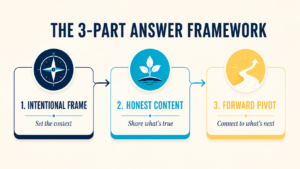
The three-part answer to “what have you been doing since your last job?”
Here is the structure. Memorize it. It is the same framework whether your time off was two months or two years.
Part 1: The intentional frame.
Start with the words “I made a deliberate decision to…”
Not “I’ve been out of work since…” Not “After I got let go…” Not “I couldn’t find anything so…”
You made a choice. Speak like someone who made a choice.
Part 2: The honest content.
Say what you actually did — and say it plainly. Without embellishment. Without apology.
“I took the summer to decompress after twelve intense years at [Company], spend real time with my family, and finish some projects around the house that had been waiting years.”
That’s it. That is a complete, confident, honest sentence. It does not require justification.
Part 3: The forward pivot.
Immediately bridge to what you want next and why now is the right time.
“That time gave me the clarity to know exactly what I want in the next chapter — a role where I can [specific value you bring]. Which is why I’m sitting across from you today.”
Put it all together and you have this:
“I made a deliberate decision to take the summer to decompress after twelve intense years at [Company], spend real time with my family, and knock out some projects that had been waiting years. That time gave me the clarity to know exactly what I want next — a role where I can [value]. Which is why I’m sitting across from you today.”
Twenty seconds. Zero apology. Total control of the narrative.
Here is what most people miss
The instinct to apologize for time off comes from a place that made sense in the 1990s and no longer applies in 2026.
The old rule was: any gap is a red flag, so cover it.
The new rule is: how you talk about the gap matters infinitely more than the gap itself.
Confident candidates who took six months off get hired. Apologetic candidates who filled every week with busywork do not. I have watched it happen hundreds of times.
Your time off is not the problem.
Your shame about your time off is the problem.
And the moment you stop treating the question like an accusation and start treating it like an invitation to tell the truth about who you are — the question stops being scary and starts being a gift.
Here’s what to do next
If interview questions like this one are the reason you are dreading your next round, you are not alone — and you are not stuck.
Most of the answers senior professionals need are not about what to say. They are about how to walk into the room with the confidence that lets you say the honest thing without flinching.
That is exactly what I teach in my free training, Stop Applying: The 3 Secrets That Actually Get You Hired.
Register for the free training here →
The hiring manager is not trying to catch you.
She is trying to hire you.
Give her a reason to.